
This article is written by and published by FISHBIO
Counting fish is no easy task, but it is a key part of research and management for many species. For the migratory salmonids that move through our rivers, scientists employ a variety of strategies to produce estimates of fish numbers, often using some variation of mark-recapture that relies on internal or external tags, manual traps, or carcass collections. Nowadays, modern technology can provide an underwater view of when, how many, and which species of fish are on the move. This allows scientists to collect direct counts of migrating fish in real-time to better inform important management decisions.
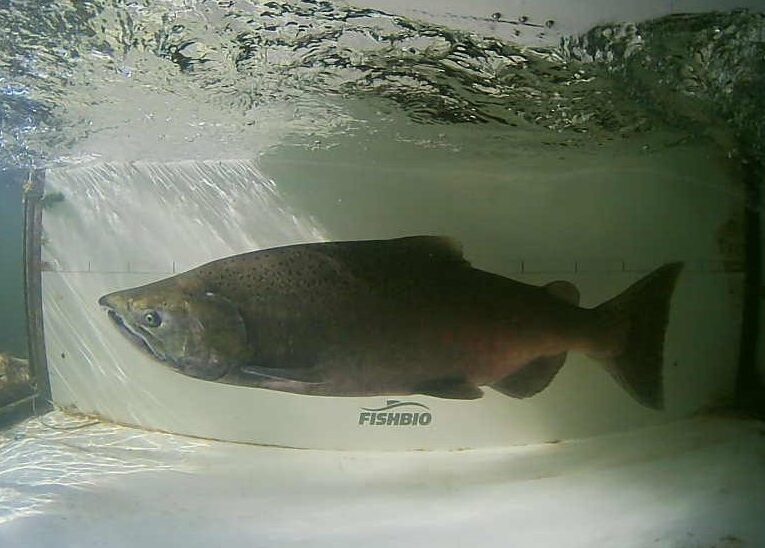
FISHBIO has been using camera systems developed by Simsonar, a Finland-based company that combines underwater video, cutting edge software, and neural network (AI) learning to meet management needs. Simsonar’s two main products, the FishCounter and LiteCounter, provide 24/7 video monitoring and automatic fish detection, measurement, and reporting. The FishCounter also offers real-time species identification using a cloud-based AI model trained on tens of thousands of images. Originally developed to recognize northern European species, the AI model is continuously retrained with imagery from FISHBIO’s local installations to identify Central Valley fishes—from Chinook salmon and steelhead to Sacramento sucker and pikeminnow. As we collect additional images of passing fish, the algorithm becomes more refined and able to recognize additional, less abundant species.
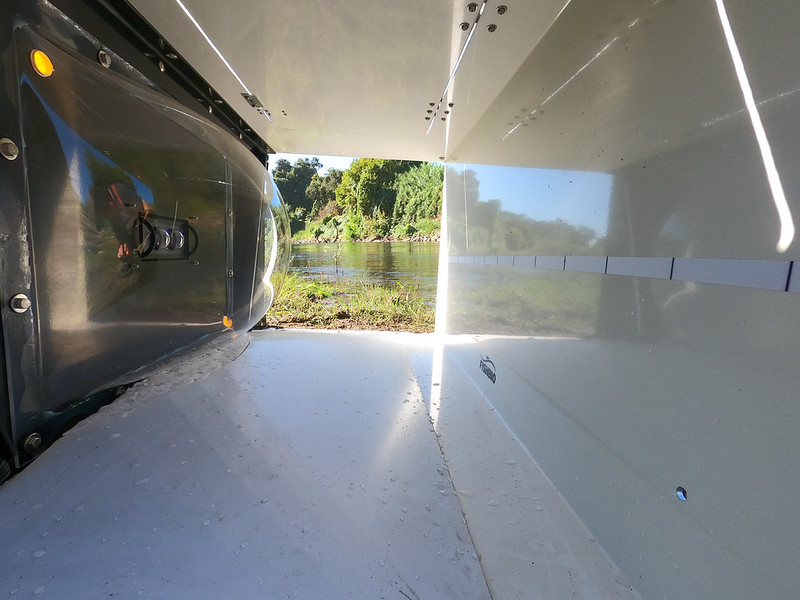
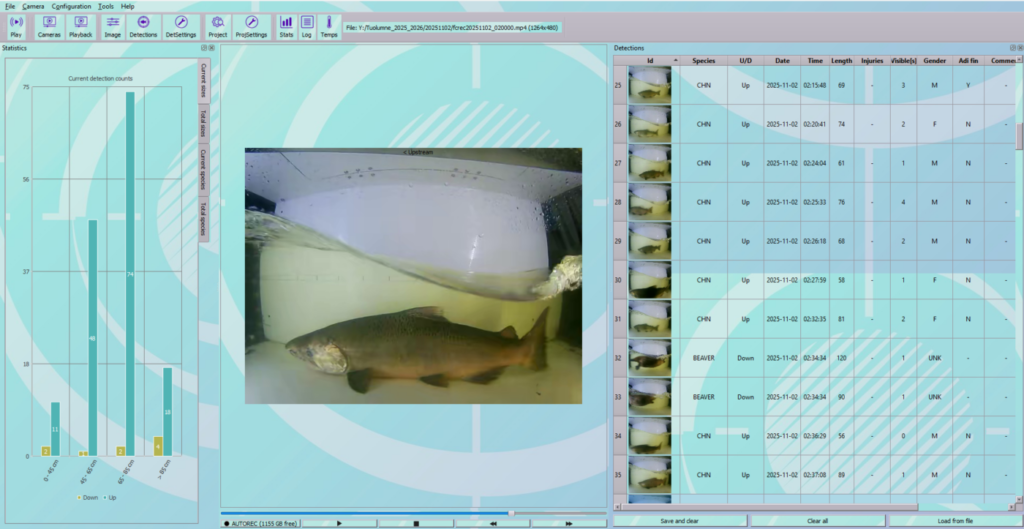
A FishCounter functions as part of a weir or similar structure that guides migrating fish through a video tunnel equipped with lights and a camera. This camera is connected to a computer running Simsonar software on-site, collecting live detections and measurements of each passage. When motion is detected in the tunnel, the software captures a brief video clip, determines if it’s a fish (and not woody debris, an otter, or even a beaver!), measures its length, and for salmonids, can record major injuries and adipose fin presence (indicating hatchery origin). On-site internet connection enables AI-driven species identification, remote access and control, and web-based reporting. The LiteCounter operates similarly but without the tunnel, making it useful for environments with preexisting infrastructure or where a tunnel is unfeasible. Their streamlined design and remote accessibility make FishCounters easy to install and use in a variety of field locations.
Underwater fish counters offer a non-invasive approach to fish monitoring by eliminating the stress that fish experience during trapping and physical handling. Other non-invasive methods often don’t capture total or real-time numbers; for example, only a subset of salmonids are acoustic or radio tagged, and an even smaller subset get detected by antennas or receivers. Carcass surveys, while critical for otolith and tag extraction, can only provide count data after spawning is complete and do not account for every fish. FishCounters, on the other hand, collect direct visual counts in real time, telling scientists exactly how many fish and which species are passing a given place at a given time. They are also especially helpful when working with large numbers of fish, which can overwhelm traps and demand around-the-clock labor. For example, this year’s Chinook salmon run on the Stanislaus River reached its highest number since 2017—more than could be reasonably trapped, counted, and measured by hand. Instead, each of these approximately 8,000 fish were detected, identified, and measured by FISHBIO using a Simsonar FishCounter.
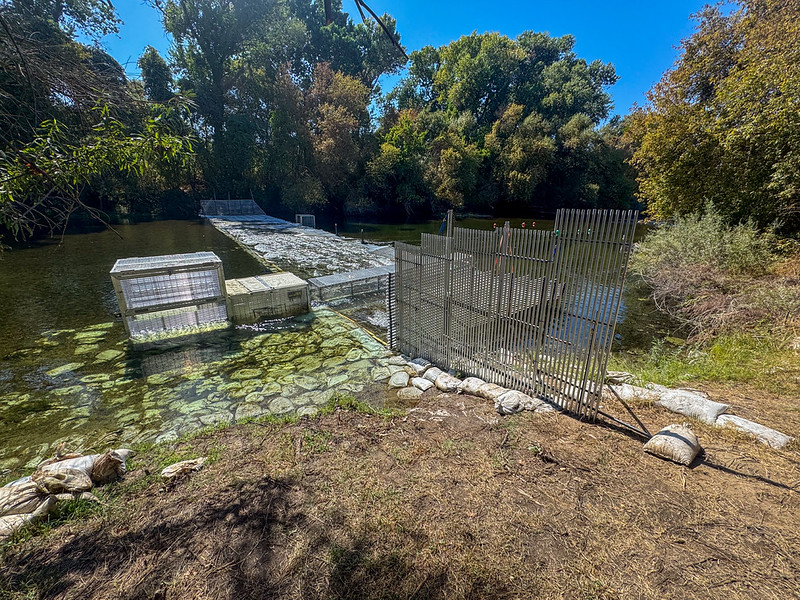
Simsonar FishCounters can be customized to a variety of projects, clients, and waterways, from conservation research to construction monitoring. As Simsonar’s North American partner and distributor, FISHBIO currently uses FishCounters to monitor steelhead trout and Chinook salmon populations on the Stanislaus and Tuolumne rivers in California’s Central Valley. Simsonar’s 24/7 automated detection and reporting allows FISHBIO to provide real-time data to stakeholders, including resource agencies, water districts, and dam operators to inform crucial management decisions. FISHBIO has also piloted other systems that utilize Simsonar technology. Recently, we teamed up with Simsonar to invent an AI-based fish sorting system as a part of a research and development (R&D) competition hosted by the Norwegian government to tackle the problem of invasive pink salmon in their rivers. Combining Simsonar’s FishCounter capabilities and FISHBIO’s fisheries and fabrication expertise, this system selectively traps invasive pink salmon while allowing native species to pass unimpeded.